
Why meetings become organisational theatre
When meetings stop being places where decisions are made and start being places where positions are performed, the real work moves elsewhere.
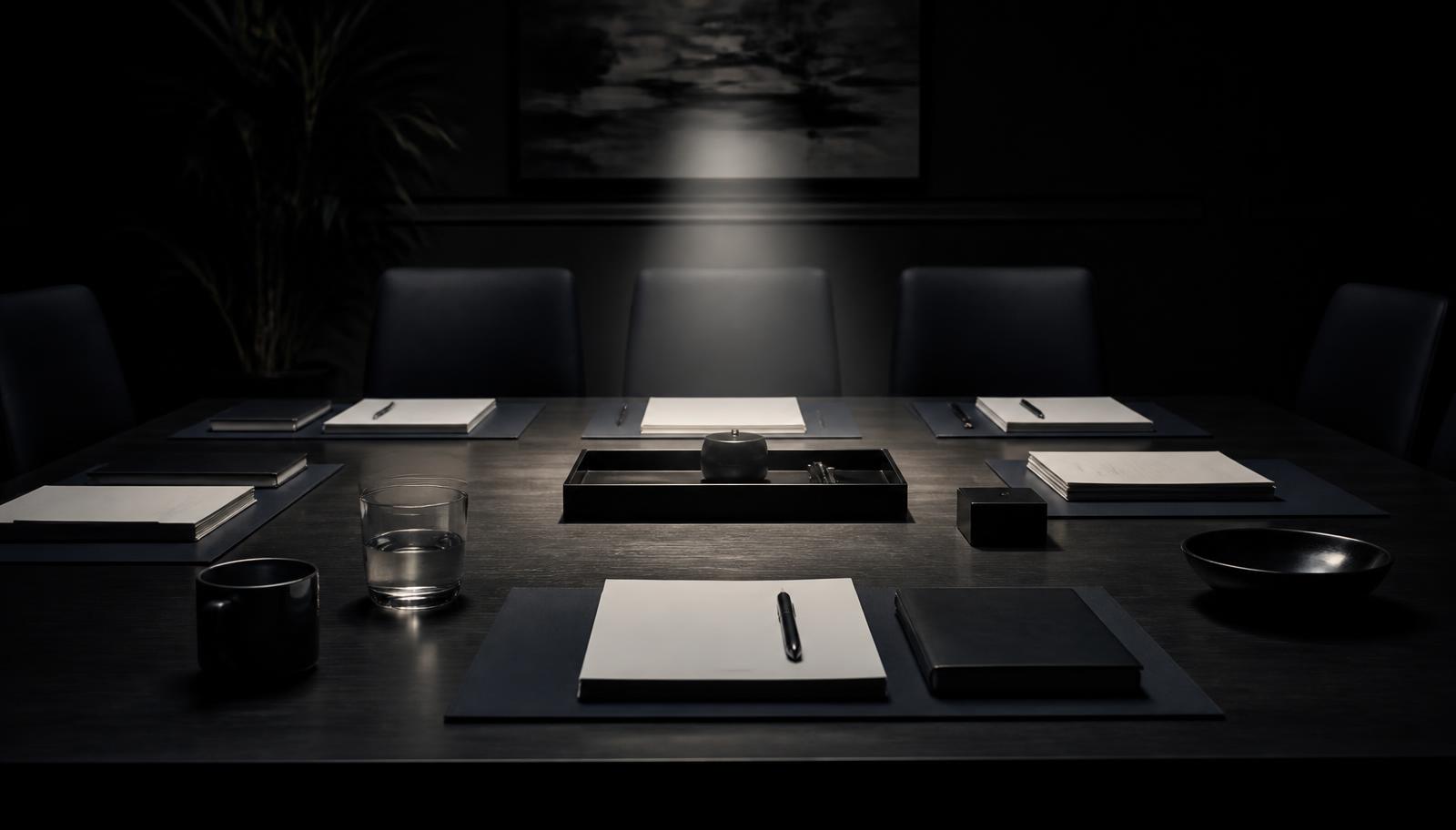
The clearest sign that a meeting culture is in trouble is not that meetings are long. It is that nobody expects anything real to happen inside them.
You can usually tell within ten minutes. People arrive with positions already agreed elsewhere. The updates are delivered in a tone that discourages questions. Someone says the word "alignment". Nobody disagrees with anything of consequence, and the meeting ends on time, which everyone treats as evidence that it went well.
Then the real meeting begins. In the corridor, on the walk to the car park, in a message thread of three people who did not feel able to say what they thought while the room was full.
Theatre is a rational response
It is tempting to treat this as a discipline problem — better agendas, tighter chairing, a rule about laptops. Occasionally that helps. More often, the performance is a rational response to what people have learned.
If raising a risk in front of a senior stakeholder has previously been treated as disloyalty, people stop raising risks in front of senior stakeholders. If a question has once been experienced as an ambush, people stop asking questions. If decisions are routinely re-opened afterwards by whoever was most persuasive in the follow-up conversation, people stop investing in the decision made in the room.
None of this requires anyone to behave badly. It only requires the organisation to have taught people, quietly and repeatedly, that candour in public carries more risk than candour in private.
What performance looks like in practice
Meetings that have become theatre tend to share a few features.
Attendance is high and contribution is low. Papers are circulated late enough that nobody can interrogate them properly or spends most of the meeting reading them. .Status updates take most of the time, because status updates are safe. Disagreement, when it appears at all, is expressed as a request for clarification.
The most reliable tell is the phrase "just to build on that" or “another way of looking at this” being used to introduce a point that directly contradicts what has just been said. Organisations develop remarkable grammatical ingenuity for avoiding the word "no".
The cost is not the time
Leaders often calculate the cost of meetings in hours. That is the smaller number.
The larger cost is that decisions get made slowly and unofficially, accountability becomes ambiguous, and the people closest to the problem learn that their information is not wanted. Work then routes around the formal system.
What actually changes it
Three things tend to shift a meeting culture, and none of them is a new template.
The first is being explicit about what a meeting is for. Deciding, consulting, informing and thinking are four different activities, and most poor meetings are two of them wearing each other's clothes. Saying at the outset "this is a decision meeting and the decision will be made here" changes what people bring.
The second is what the most senior person does with the first piece of bad news. That moment is watched carefully, and it sets the price of honesty for months afterwards. Leaders who thank someone properly for an unwelcome point — and then act on it — buy themselves better information for a long time.
The third is closing the loop. If people can see that what was said in the room shaped what happened next, the room becomes worth speaking in. If the decision quietly changes afterwards, they will draw the obvious conclusion.
A question worth sitting with
Ask your team, individually and without a form: where does the real conversation about this happen? If the honest answer is consistently "afterwards", the meeting is not the problem. It is the symptom.
“The clearest sign a meeting culture is in trouble is not that meetings are long. It is that nobody expects anything real to happen inside them.”