01
Declared organisation
The values, strategy, policies, presentations and public commitments: what the organisation wants people to expect.

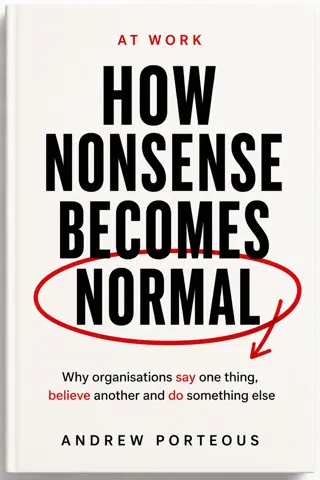
Book in development
Why organisations say one thing, believe another and do something else
Most of us are taught how to get a job. Very few of us are taught how to read the organisation once we are inside it.
Andrew Porteous has spent more than forty years working in and around organisations, trying to understand how intelligent, well-intentioned people can make perfectly sensible choices that add up to organisational nonsense.
The central lens
01
The values, strategy, policies, presentations and public commitments: what the organisation wants people to expect.
02
The picture leaders and other insiders sincerely hold in their heads: the explanations, assumptions, measures and stories that tell people what sort of organisation this is.
03
The organisation revealed by decisions, budgets, rewards, promotions, exceptions, tolerated behaviour, informal power and consequences.
The interesting gap is not simply between what an organisation says and what it does. It is between what reasonable people have come to believe and what the organisation repeatedly teaches them through experience.
Why this book?
Meetings, politics, appraisal, change, bad news, damaging managers, silence and withdrawn care can look like separate workplace irritations. The book connects them to the ordinary organisational machinery that makes some forms of nonsense surprisingly rational and surprisingly durable.
The oddness has a structure.
Part of that structure is organisational self-deception: not deliberate dishonesty, but the ordinary ways identity, selected evidence, filtered information and visible activity can allow a reassuring account to survive.
In brief
Questions nobody answers
“The website gets Friday. Monday morning supplies some more evidence.”
This is not a score. It is a way of collecting better evidence.

About the author
Andrew Porteous is an organisational and people-development consultant who has spent more than forty years working across organisations, over twenty-five of them as a consultant. His authority in the book comes less from being a guru and more from repeatedly seeing the same patterns from different levels, functions and sectors — and occasionally realising he was part of the nonsense too.
“I am human and write this to my fellow humans.”About Andrew
For teams and organisations
The book is being developed not only as an individual read but as a way for teams to talk about the gap between what they intend, what they believe and what their operating system actually produces.
Talk to AndrewPossibilities as the book develops
Book in development
Andrew is continuing to refine the manuscript, stories and practical material. This page will develop with the book.